I am an traditional home economist who loves to sew and to teach sewing classes. My field is now called FACS-Family and Consumer Sciences. There is a lot of science and a lot of consumerism involved in this discipline but I always preferred the original title “Home Economics” possibly because even though I learned to sew at home at age 8, I was introduced to the profession in my 7th grade Home Economics class. My college degree is in Home Economics. My masters degree is in Home Economics Education and my New York State teaching license is for Home Economics. Change is hard even after all these years. There is much more to home economics than sewing but for now…
Why Is Sewing Education So Important?
My high school classroom was a soft space in the day for my students to land. It was a place to learn and create without pressure, without criticism and with lots of self-esteem building. I designed projects so that students could be successful, feel good about themselves, feel accomplished and proud. It was a break in the day from all the academic pressure they were under. Sewing class also gave students an opportunity to learn hands on, to create and to learn a useful skill.
Sewing is a creative and enjoyable way to learn and use math skills including fractions, yardage, metrics and geometry. I can’t tell you how often I taught fractions in sewing class. Many of my high school students did not know how to recognize or measure 1/4″, 5/8″, 3/4″ , how many inches were in a yard or a fraction of a yard or how to figure out the circumference of a circle skirt waist-but they did learn when the learning occurred hands on when making a garment.
If a person learns to sew, read pattern instructions and put together a 3 dimensional creation, they can also learn woodworking, carpentry, and many skills in the filed of machinery, automotive, electricity and plumbing. The skills are the same: following diagrams, following written directions, use spacial skills to make things fit together, visualizing a part of a whole and what the finished product will look like. I often taught how to mitre the corner of a pocket-a skill transferable to mitering in wood working.
Did You Know…
Sewing teaches problem solving skills.
Sewing teaches science concepts when learning the properties natural and synthetic fibers and different types of dyes, weaves and finishes.
Sewing helps develop artistic skills when working with color, line, design, proportions etc.
Working with fabrics as you sew, and learning proper construction makes a person a better consumer and more equipped to purchase and care for garments properly.
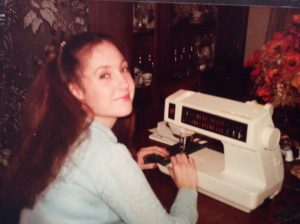
This is me with the first sewing machine I purchased the year I had my first teaching job. It is a Singer 2010 Touch Tronic. I still have it!


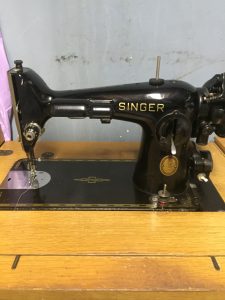
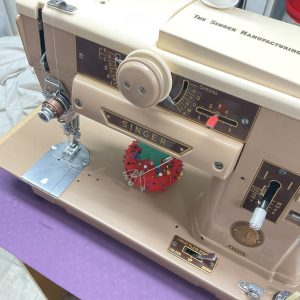
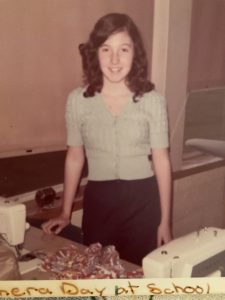
The black Singer is the sewing machine my grandmother taught me to sew on. The beige machine is my Mother’s Singer 401A which I sewed on most of my childhood and teenage years. It is a very in demand vintage machine and I still have it and use it. The other picture is me in 9th grade, the year I decided I wanted to be a home economics teacher. We had Singer 717 and 719’s in school.
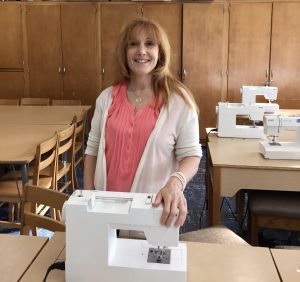
Me in my sewing classroom. By this time, we had Pfaff sewing machines in the classroom but still had the Singer 717’s in the desks! Today I am retired from high school teaching but continue to teach sewing classes at local libraries.